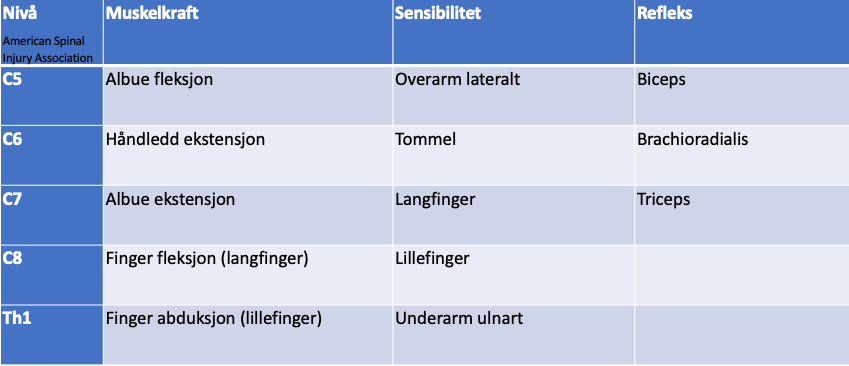
Key examinations for radiculopathy C5-Th1

Special test for the neck


Wainner R. et al. Reliability and diagnostic accuracy of the clinical examination and patient self-report measures for cervical radiculopathy. Spine. 2003;28:52-62
ASIA and ISCoS International Standards Committee. The 2019 revision of the International Standards for Neurological Classification of Spinal Cord Injury (ISNCSCI) - What’s new? Spinal Cord. 2019 Oct;57(10):815-817. doi: 10.1038/s41393-019-0350-9. Epub 2019 Sep 17. PMID: 31530900.

C5 (key tests highlighted):

Elbow flexion (biceps muscle), Biceps reflex, Sensation lateral upper arm.

  • Shoulder abduction (supraspinatus and deltoid muscles)
  • Shoulder external rotation (infraspinatus muscle)
  • Shoulder internal rotation (subscapularis muscle)

C6 (key examinations highlighted):

Wrist extension (m. extensor carpi radialis and ulnaris, Brachioradialis reflex, Sensation radial forearm and thumb.

  • Elbow flexion (m. biceps)

C7 (key examinations highlighted):

Elbow extension (m. triceps), Triceps reflex, Sensation of the 3rd finger.

  • Wrist flexion (m. flexor carpi radialis and ulnaris)
  • Finger extension (m. extensor digitorum communis, indicis proprius and digiti minimi)

C8 (key examinations highlighted):

Finger flexion (m. flexor digitorum superficialis, profundus and lumbricals), Sensation of the 5th finger.

  • Thumb extension (m. extensor pollicis)
  • Thumb adduction (m. adductor pollicis)
  • Ulnar deviation of the wrist (m. flexor carpi ulnaris and m. extensor carpi ulnaris)

Th1 (key examinations highlighted):

Finger abduction of the 5th finger (m. abductor digiti minimi), Sensation of the ulnar forearm.

  • Finger abduction and adduction (m. interosseus)

Radicular pain from a nerve root
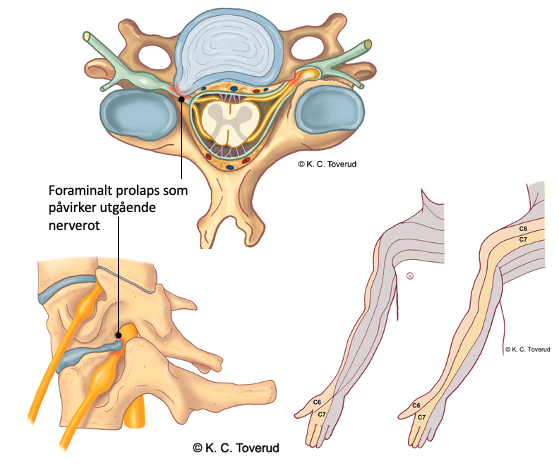
Radicular pain from a nerve root
  • Wear or injury of an intervertebral disc in the neck can cause a herniation that presses on a nerve root, most commonly C6 and C7
  • Examination often shows asymmetrically reduced range of motion in the neck. Movement towards the painful side can cause local neck pain and pain radiating in a dermatome
  • Positive Spurling test, pain radiating into the arm
  • Clinical examination may reveal reduced strength, reduced sensation and diminished reflexes, either alone or in combination (Sens 7, SPec 98, LR+3.5, LR-0.94)

Somatic and visceral branches

Somatic and visceral branches
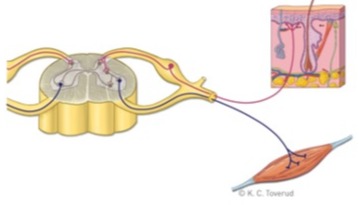
  • The ventral root with somatic and visceral branches forms the spinal nerve together with the dorsal root
  • The spinal nerve divides into a dorsal and a ventral branch
  • The somatic motor branches innervate skeletal muscle
  • The visceral motor branches innervate smooth muscle

Overlap between myotomes

Overlap between myotomes
  • If a nerve root is affected by a herniation and causes radiculopathy, isometric testing of muscle strength will show mild to moderate weakness
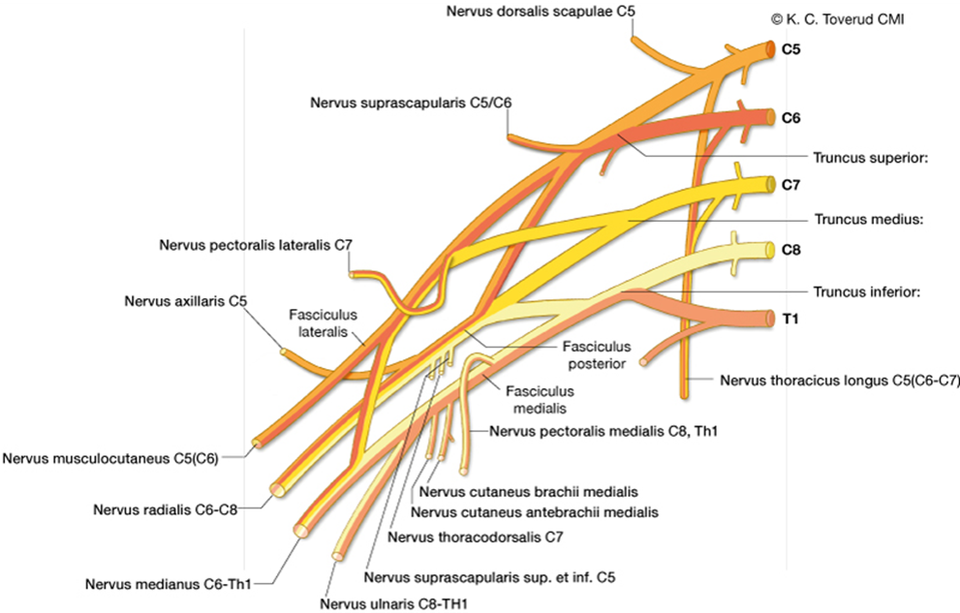
  • For example, a severe C6 radiculopathy will cause weakness of m. biceps brachii (n. musculocutanus) on testing, but not paralysis, because motor fibres from C5 also innervate m. biceps brachii

Overlap between dermatomes

Overlap between dermatomes
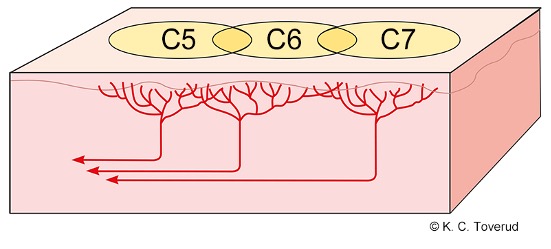
  • All spinal nerves (except C1) innervate an area of skin, a dermatome
  • There is considerable overlap between the dermatomes
  • Sensory loss is difficult to demonstrate if only one spinal nerve is affected

The degree of nerve compression determines the radicular symptoms
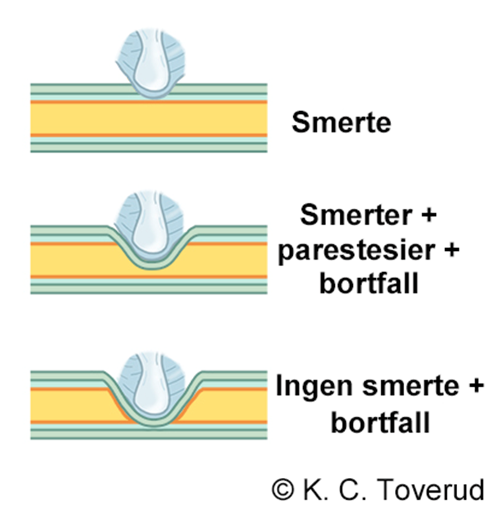
The degree of nerve compression determines the radicular symptoms

Symptoms appear in the following order, depending on the degree of pressure on the dural sleeve and the spinal nerve

  1. Pain
  2. Pain + Paresthesia + Loss
  3. Loss (reduced strength, reduced sensation, diminished reflexes), but no pain

Cervical myelopathy

Cervical myelopathy
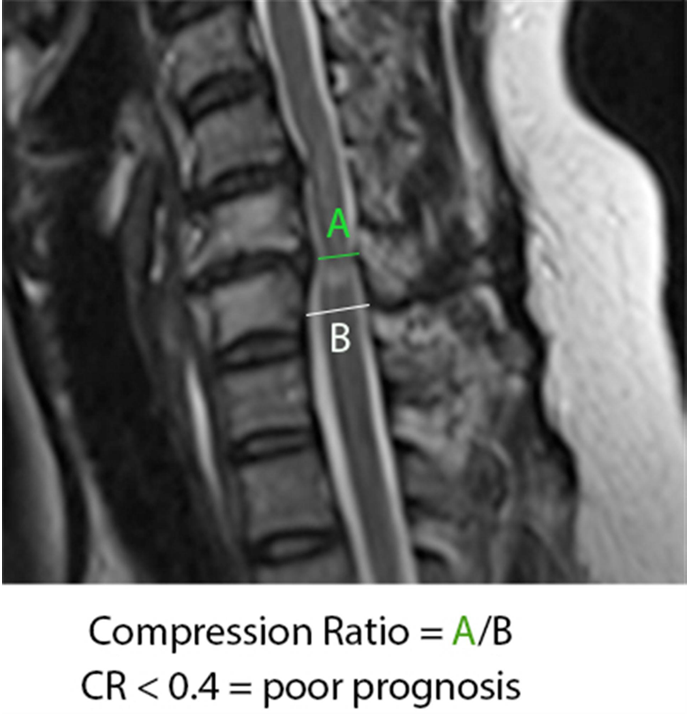
  • Neck pain, neck stiffness, headache
  • Numbness and tingling in the hands that does not follow dermatomes
  • Weakness and impaired fine motor skills in the hands (clumsiness, dropping things)
  • Walking difficulties, spastic scissor gait, unsteadiness
  • Urinary retention, urgency
  • Hyperreflexia
  • Babinski sign
  • Positive Romberg test
  • Lhermitte sign (electric shooting pain down the back and into the arms on neck flexion)

Topography of the cervical spinal nerves
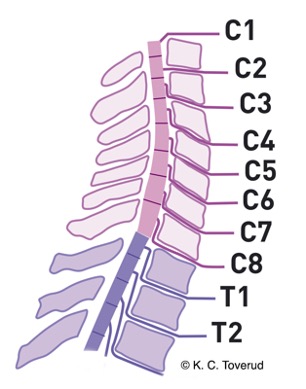
Topography of the cervical spinal nerves

Cervical spinal nerves

  • C1 exits between the skull base and the C1 vertebra
  • C2-C7 exit through the neural foramina above vertebrae C2 to C7
  • C8 exits through the neural foramen above vertebra Th1
  • Th1 exits through the neural foramen below vertebra Th1

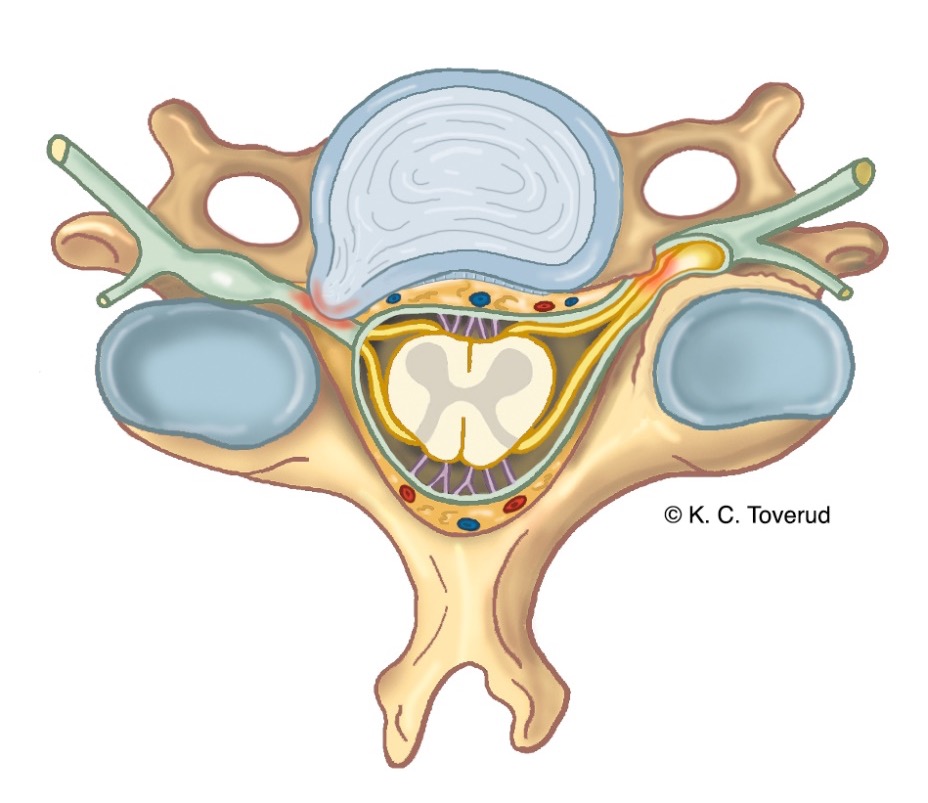
Cervical nerve roots run horizontally
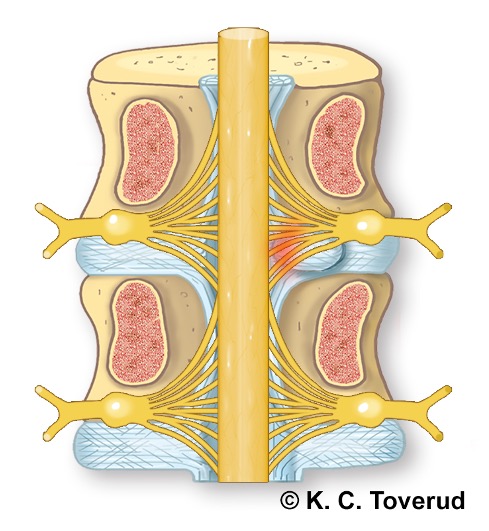
Cervical nerve roots run horizontally
  • Cervical nerve roots exit horizontally
  • Central and foraminal disc herniations affect the same nerve root
Back to the neck